Presented by Boss Shotshells and The Green Way Outdoors
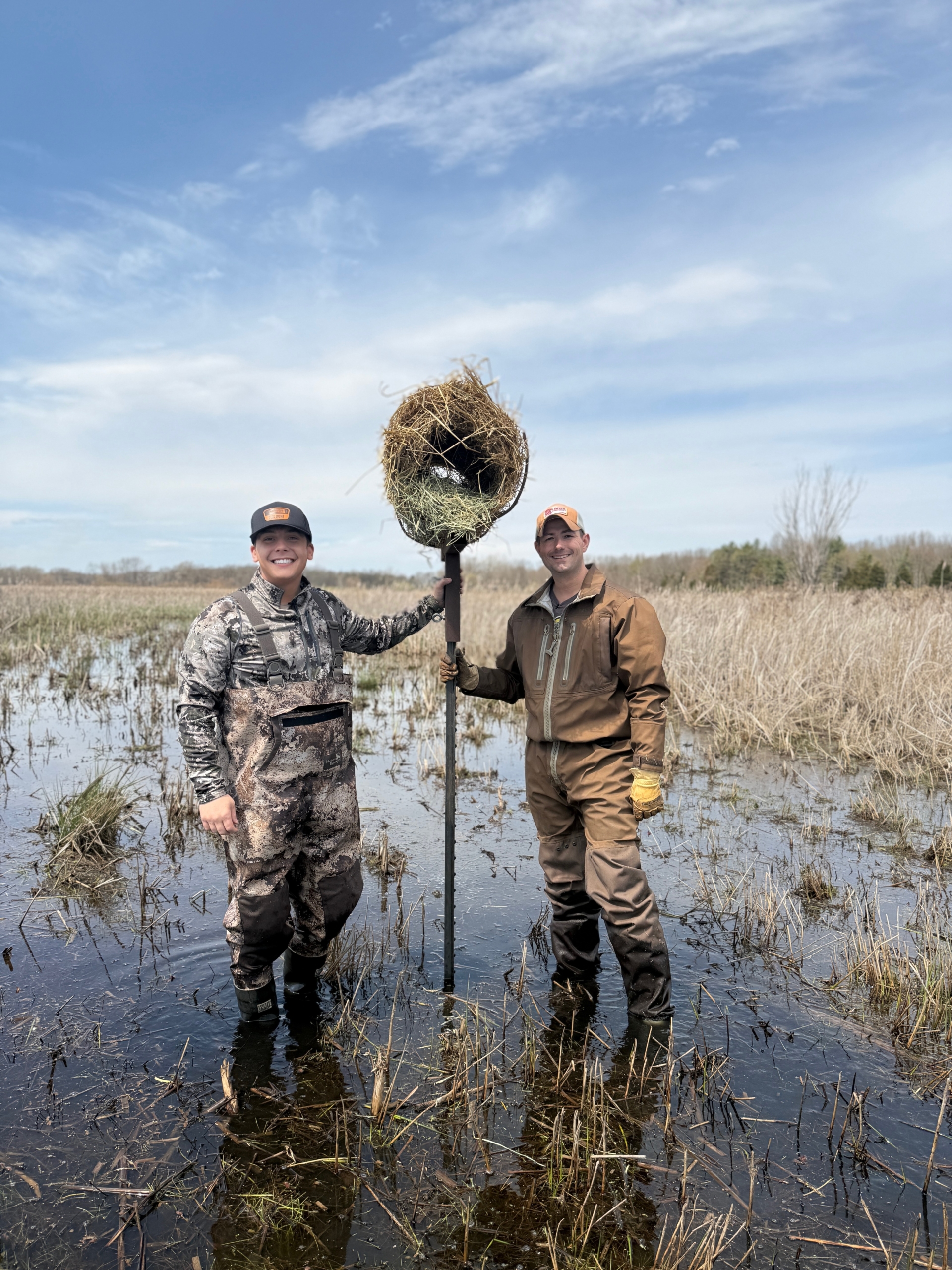
Last year, before the first flock of ducks ever hit the decoys, we spent time in the marsh doing something just as important as the hunt itself, conservation. With our friends from Boss Shotshells by our side, we built mallard hen houses. These simple nesting structures are one of the most effective ways hunters can help sustain duck populations for generations to come. Each hen house provides a safe, dry place for a mallard to lay her eggs, away from predators and rising water. It is a hands on project that connects hunters to the bigger picture, the cycle of life we take part in every season.
What’s a hen house and why do they matter?
A hen house, also called a mallard nesting tube, is a rolled cylinder of welded wire and straw mounted horizontally over water on a post. By lifting a hen’s nest above the reach of most mammalian predators and keeping it dry through spring storms, hen houses dramatically improve nest success for mallards. In places where ground nests may succeed less than 10 percent of the time, properly placed hen houses often boost success to 60 to 80 percent, well above the 15 percent needed just to maintain populations.
How hen houses help mallards
Predator avoidance: Elevation over water makes eggs and hens harder targets for raccoons, skunks, foxes, and mink.
Weather protection: The double roll of straw sheds rain and helps keep the nest warm and dry through cold snaps.
Early nesting opportunity: Secure, dry nest sites encourage earlier attempts, and hens will often reuse successful spots in following years.
Cost effective conservation: Large clusters of hen houses produce a lot of ducklings for modest materials and volunteer time.
Fun facts about mallards and nesting
Typical clutch size is 1 to 13 eggs, and incubation lasts about 23 to 30 days.
Ducklings are ready to leave the nest within about 13 to 16 hours after hatching, often early in the morning, and the hen leads them to water.
If a nest fails, mallards commonly re nest, and some hens have been documented making multiple attempts in a single season.
Both urban and wild mallards readily use artificial nesting structures, another reason hen houses work in so many places.
Build one step by step
Skill level: Basic shop skills such as cutting, drilling, and hog ringing
Best timing: Late winter through early spring before nesting starts
Safety: Wear gloves and eye protection, use a life jacket and proper ice safety if installing over frozen water, and never service or move an active nest with eggs or chicks without proper permits.
Materials per hen house
- Straw or hay, flax straw is ideal and durable grass hay works for nest fill
- Welded wire fencing, one 7 foot by 3 foot section, 2 inch by 1 inch mesh, 14 gauge
- Mounting hardware
- 8 foot base pipe made from 1.5 inch square tubing
- 30 inch insert pipe made from 1 inch square tubing with height adjustment holes
- 18 inch cradle support made from 1 inch square tubing
- Two 20 inch lengths of quarter inch steel rod bent into semicircles to form cradle hoops
- Hog rings, about a dozen, and a bolt or wire lock pin
- Optional, 14 gauge fence wire or U bolts for extra ties
-
- Prep the post parts. Drill 2 to 3 equally spaced holes in the 30 inch insert pipe for height adjustment, and drill one hole about 8 inches from the end of the base pipe. Weld the insert to the 18 inch cradle support to form a T, then weld the two quarter inch rods as semicircular hoops at each end.
- Form the inner core. Roll 3 feet of your 7 foot by 3 foot wire panel into a tight cylinder and secure with 3 to 4 hog rings.
- Add the straw layer. Spread roughly 2 inches of flax straw or durable substitute over the remaining 4 feet of wire panel. Continue rolling tightly until you have a double wall cylinder. Hog ring the end to close the tube. Aim for an 11 to 12 inch opening at each end, because bigger than that and Canada geese may move in.
- Nest fill. Before installation, add grass hay inside so the tube is half to two thirds full. Hens will finish the bowl with down.
-
- Height: Mount the tube about 3 feet above the spring high water mark or 2 to 4 feet above water in spring.
- Location: Set in shallow, open water, roughly 3 to 5 feet from emergent vegetation such as cattails or bulrush, not tangled within it.
- Facing: Point the tube away from prevailing winds to reduce drafts and straw loss.
- Spacing: As a rule of thumb, place 1 to 2 structures per about 3 acres of open water.
- Install smart: Drive the support pipe more than 2 feet into the substrate. In cold regions, many crews install through safe ice for stability and ease.